
Artificial intelligence has changed dramatically in recent years. Tools like ChatGPT can write, code, create images, and answer complex questions. But these systems are still far from matching the full range of human intelligence. That bigger goal is known as artificial general intelligence, or AGI. AGI refers to a theoretical AI system with abilities comparable to human intelligence. It could potentially reason, learn, solve problems, understand language, and perceive the world. Unlike today’s specialized AI, AGI would not be limited to specific tasks.
What Exactly Is AGI?
Artificial general intelligence is still a theoretical concept rather than an existing technology. The idea is to create machines capable of performing intellectual tasks at a human level. Such systems could potentially learn new skills without extensive task-specific training. They could reason through unfamiliar situations and understand complex context. AGI could also combine different abilities instead of handling them separately. This might include language comprehension, perception, creativity, reasoning, and problem solving. In the strongest versions of the concept, AGI could even understand the meaning behind its actions.
AGI And The Turing Test
The idea of human-level machine intelligence has been discussed for decades. Computer scientist Alan Turing proposed a famous test for evaluating machine intelligence. The Turing test asks whether a machine can communicate well enough to appear human. If its responses become indistinguishable from a person’s responses, it could be considered to have passed. However, no AI system has definitively reached that standard according to the source material. Today’s AI can produce impressive responses, but human-like understanding remains a much larger challenge.
Today’s AI Is Not AGI
It is easy to think that modern AI is already close to AGI. Generative AI tools can write essays, generate images, produce code, and handle many other tasks. However, these systems work differently from human intelligence. Many current AI models are essentially highly capable prediction systems. They learn patterns from enormous amounts of training data and use those patterns to generate responses. This can produce remarkable results, but it does not necessarily mean the system understands the world like a human. Human intelligence involves broader reasoning, perception, creativity, learning, and emotional understanding.
How Far Away Is AGI?
Nobody knows exactly when AGI will become reality. Predictions range from a few decades to centuries or beyond. Many researchers and academics believe AGI is still decades away. Some are even less optimistic about seeing it during this century. Rodney Brooks, a roboticist and iRobot cofounder, has suggested that AGI could arrive as late as 2300. These widely different predictions show just how uncertain the timeline remains. The technology could progress faster than expected, or fundamental challenges could take much longer to solve.
How Will People Access AGI?
The way people interact with AI could change dramatically as the technology develops. Today, most people access AI through laptops, smartphones, and other traditional screens. Future interfaces could become much more immersive. Augmented reality and virtual reality could allow people to interact with AI in virtual environments. Brain-computer interfaces could create another possible path. Neuralink, for example, implanted a brain chip in a human in January 2024. The long-term goal includes allowing users to control computers through thought. Robots could become another physical interface between humans and intelligent machines.
Why Robots Matter For AGI
[image source:robot-magazine]
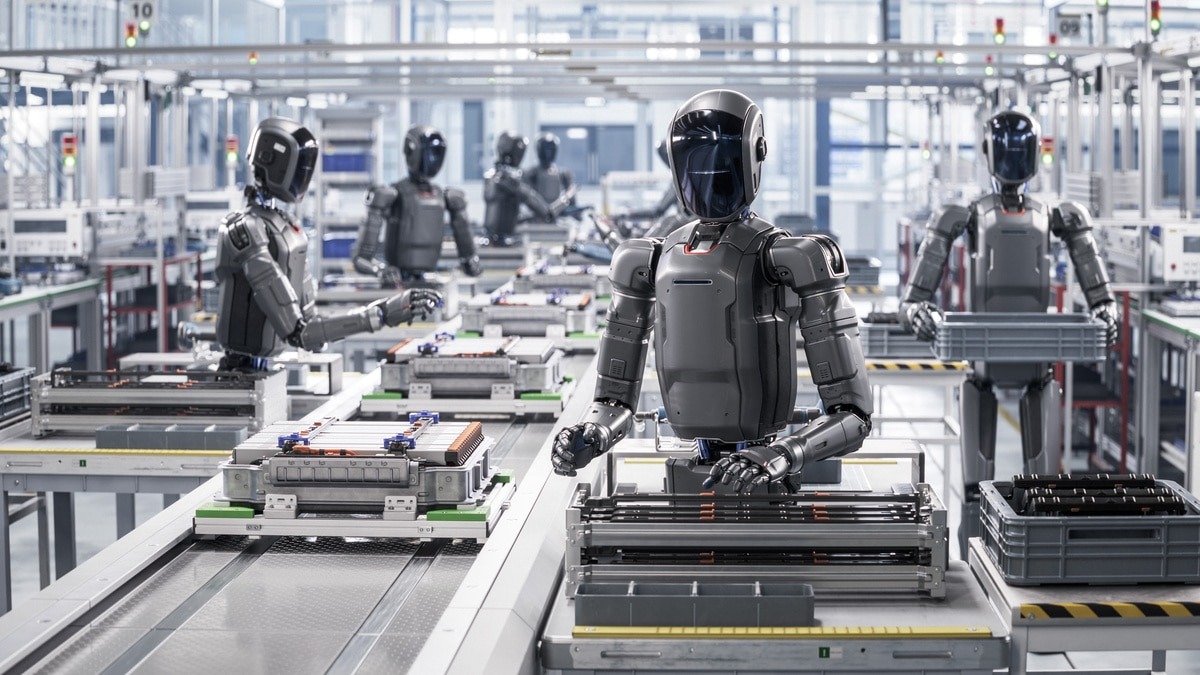
Robots could play an important role in developing more advanced forms of AI. A robot is essentially a machine capable of performing tasks independently or with limited human assistance. More sophisticated robots can also sense and interact with their surroundings. Programmable robots have been used since the 1950s. Today, millions of robots operate across factories and other environments. As AI software improves, robots are becoming better at walking, sensing, communicating, and manipulating objects. This combination of physical machines and advanced AI could become important for future AGI research.
The Rise Of Humanoid Robots
Humanoid robots are designed to perform tasks in ways that resemble human behavior. They can be built with human-like bodies, movements, communication abilities, or cognitive systems. Sanctuary AI’s Phoenix is one example of a modern humanoid robot. The robot can walk, lift objects, and perform practical workplace tasks. These systems are becoming increasingly capable as AI models improve. Future humanoids could learn from their physical surroundings instead of relying only on pre-programmed instructions. That could help researchers explore new approaches toward general intelligence.
Different Types Of Robots
Robots already operate across many industries and environments. Stand-alone autonomous industrial robots use sensors and computing systems to navigate and perform manufacturing tasks. Collaborative robots, or cobots, are designed to work alongside humans and handle repetitive or dangerous activities. Mobile robots use wheels or similar systems to move through warehouses and factories. Military organizations also use mobile robots for reconnaissance and bomb disposal. Human-robot hybrids can combine robotic components with human bodies or brain interfaces. Humanoids and androids aim to reproduce increasingly human-like movement, communication, and cognition.
What Could Speed Up AGI?
Several major advances could influence the development of AGI. Researchers are exploring improvements in algorithms, computing infrastructure, robotics, and data. However, achieving human-level intelligence may require approaches that go beyond today’s systems. Embodied cognition is one interesting idea. It suggests that intelligent systems may need to learn through physical interaction with their surroundings. Humans learn through multiple senses and experiences from an early age. Robots could potentially develop similar abilities by interacting directly with the physical world.
Better Algorithms And Robotics

[image source:Tech Xplore]
Future AGI systems may require completely new algorithmic approaches. Current AI systems have achieved impressive results through deep learning and large-scale training. However, researchers are still investigating how machines can develop broader forms of cognition. Large language models give robots advanced language abilities. Large behavior models can help robots learn human actions and movements. These models are trained using large datasets containing examples of human behavior. Better systems could eventually allow robots to perform many tasks with limited task-specific training.
Computing Power Could Be Critical
The rapid development of AI has depended heavily on advances in computing. Graphics processing units, or GPUs, have played an important role in training modern neural networks. Their ability to process many calculations simultaneously makes them highly useful for AI workloads. GPUs also provide high memory bandwidth for moving large amounts of data quickly. Future AGI systems could require even greater computing capabilities. Quantum computing is sometimes suggested as one possible technology that could contribute. However, current quantum computers are not yet ready for widespread everyday applications.
More Data Could Drive Progress
Data is another major part of AI development. Modern AI systems learn from enormous collections of information. Future AGI may require much larger and more diverse sources of training data. Connected devices could generate additional information through the Internet of Things. However, simply increasing data volume may not be enough. New robotics approaches could create entirely different sources of training information. Human-like robots could collect data through sensors that mimic aspects of human perception. Self-driving cars already demonstrate how real-world systems can generate useful training data.
What Can Businesses Do About AGI?
AGI may still be decades away, but businesses cannot ignore current AI progress. Companies should continue monitoring developments in artificial intelligence and emerging AGI research. Building relationships with startups and tracking important technological changes can help businesses prepare. Organizations should also think about governance, boundaries, and responsible AI use. Preparing early could make the transition toward greater automation easier. The goal is not necessarily to predict the exact arrival date of AGI. Instead, businesses should understand how today’s AI is already changing their industries.
Invest In AI Now
Companies that delay AI adoption could struggle to compete as the technology develops. Organizations are already exploring AI across different industries and business functions. Investing in AI can help companies understand its practical value before future systems become more capable. Businesses can experiment with tools while developing internal expertise. They can also identify areas where automation could improve productivity. The key is to invest carefully while learning what works. Waiting until AGI arrives could leave organizations unprepared for a rapidly changing economy.
Keep Humans At The Center
AI development should not mean removing humans from every important process. Human-machine interfaces can help people work alongside increasingly capable AI systems. Human-in-the-loop technologies are one way to maintain human involvement. Employees will need training and support as automation changes their responsibilities. AI should be treated as a tool that can extend human capabilities. Organizations that combine human judgment with machine intelligence may be better prepared for future changes.
Ethics And Security Matter
More powerful AI systems also create important ethical and security challenges. Businesses will need to consider cybersecurity, privacy, and algorithmic bias. These issues become even more important as AI systems gain greater influence. Organizations should establish clear rules around how AI is developed and used. Responsible governance can help reduce potential risks while allowing useful innovation. Preparing for advanced AI therefore requires more than technical investment. It also requires careful thinking about how these systems affect people and society.
Building The Right Foundation
AI systems depend heavily on data, talent, and technical capabilities. Businesses should build strong foundations before attempting more ambitious AI projects. High-quality data is especially important for developing reliable AI systems. Companies also need people who understand both technology and business requirements. Strong internal capabilities can make it easier to adopt new AI tools. Organizations should therefore treat AI preparation as a long-term process rather than a single project.
Preparing For New Ways Of Working

[image source:Bitrix24]
Advanced AI could also change how companies organize their workers. Traditional organizational structures may become less suitable as AI accelerates the pace of work. Companies may need more flexible teams that can move between different projects. Employees could collaborate with AI systems across multiple functions. This could create new economies of scale and new skill requirements. Preparing workers for these changes will be just as important as adopting new technologies.
Small Bets Can Reduce Future Risk
Businesses do not need to predict the future perfectly. Instead, they can make smaller investments that preserve strategic options. Companies could experiment with AI startups and emerging technologies relevant to their industries. Not every investment will succeed, and that is expected. The goal is to learn while reducing exposure to future disruption. Small bets can help businesses understand emerging technologies before they become mainstream.
The Bigger Picture
AGI remains one of the biggest unanswered questions in artificial intelligence. Nobody can say exactly when it will arrive or what form it will take. Some predictions suggest decades, while others extend far into the future. What is clear is that AI is already advancing rapidly. Generative AI is changing how people create content, write software, and solve problems. Robotics, computing, and data could push that progress even further. The eventual arrival of AGI could reshape businesses, economies, and societies on an enormous scale.
Final Thoughts
Artificial general intelligence remains theoretical, but the research behind it continues to advance. Today’s AI systems are impressive, yet they still differ significantly from human intelligence. Achieving AGI may require breakthroughs in algorithms, computing, robotics, and data. It may also require machines to learn from the physical world like humans do. Businesses should not wait for AGI before preparing for the future. They can start by investing in AI, developing talent, strengthening data, and addressing risks. Whether AGI arrives in decades or much later, the path toward it is already changing the world.
Have an idea worth building?
Turn your ideas into scalable software with Techfilos. From product development to AI and cloud engineering, we build technology designed for real-world growth.