Silicon Valley is famous for building technology at incredible speed. But Poseidon Aerospace is taking a more practical approach. The company wants to make cargo transportation faster, cheaper, and more efficient. Instead of chasing flashy aviation technologies, Poseidon is focused on logistics. Its goal is simple: move cargo efficiently using autonomous aircraft. The startup was founded by David Zagaynov and Parker Tenney. Zagaynov previously worked on logistics at Amazon during 2024. Tenney previously worked at Lockheed Martin before joining Poseidon. The founders often discussed the growing advanced air mobility industry. They noticed many startups focused heavily on introducing new technologies. Poseidon decided to approach the problem from a different direction. Rather than starting with technology, it started with cargo transportation.
Building The Future Of Aerologistics
Poseidon wants to build what Zagaynov calls the future of aerologistics. The company believes cargo transportation does not need unnecessary complexity. Many aviation startups are developing vertical takeoff and landing aircraft. Others are experimenting with hydrogen or electric powertrains. Poseidon has chosen none of those approaches for now. Instead, it is building aircraft around existing technologies. The company believes improving cargo transportation should come first. Technology should support that mission rather than become the mission. This philosophy has shaped Poseidon’s aircraft design.
$60 Million Series A Funding
Poseidon Aerospace has raised significant funding for its ambitious plans. The company recently closed a $60 million Series A funding round. The round was led by early-stage VC firm TQ Ventures. New investors included Hanwha Asset Management and G Squared. JAWS also participated in the latest funding round. Existing investors also returned to support the company’s next stage. Those investors include Starship Ventures, Draper Associates, and Drover Ventures. Poseidon previously raised $11 million through its seed funding. The latest investment gives the startup considerably more resources. It can now accelerate aircraft development and expand its team. The company is also preparing for its first full-scale test flight.
Meet Egret
Poseidon’s main aircraft is called Egret. It is an uncrewed cargo aircraft designed for regional transportation. The company expects Egret to conduct its first test flight. That flight is expected before the end of this year. Egret is designed as a fixed-wing aircraft. It has a wingspan of approximately 50 feet. Unlike many aviation startups, it does not use vertical takeoff. It also does not depend on electric propulsion. Instead, Egret uses a conventional combustion engine. This design reflects Poseidon’s focus on practical economics. The company wants Egret to transport cargo at lower costs.
Why Poseidon Avoids Electric Power
Electric aviation has attracted enormous attention in recent years. However, electric aircraft still face major limitations for cargo operations. Battery energy density remains a major challenge for longer flights. Poseidon believes conventional fuels currently offer greater energy density. That makes combustion engines attractive for its specific mission. The company is not trying to create the most futuristic aircraft. It is trying to create an aircraft that moves cargo economically. That difference defines Poseidon’s overall strategy.
No Cockpit, No Pilot

[image source: BBC]
One of Poseidon’s biggest advantages comes from removing the pilot. Egret is designed for autonomous operation and remote piloting. Removing the cockpit creates more room for useful cargo. It also eliminates systems required to support pilots. Life-support equipment and cockpit components add significant weight. Without them, the aircraft can become much lighter. A lighter aircraft can require smaller and more efficient engines. That creates a positive cycle throughout the aircraft’s design. Less weight can mean better efficiency and greater payload capacity. Poseidon believes this approach can reduce operating costs significantly.
The Economics Of Autonomous Cargo
Pilot costs are an important part of traditional aviation operations. Pilots also have strict limits on how long they can fly. This creates operational challenges for regional cargo carriers. A pilot may fly several hours in one direction. They may then need accommodation before returning. That means aircraft can spend significant time waiting between flights. Poseidon believes removing pilots could change that equation. The aircraft could potentially operate with much higher utilization. Higher utilization means expensive aircraft spend less time sitting idle. That could make regional cargo transportation more efficient.
A Different Kind Of Air Cargo Network
Poseidon is also thinking beyond traditional cargo routes. Most regional cargo networks rely heavily on hub-and-spoke systems. Cargo moves through central hubs before reaching its final destination. Poseidon wants to explore more direct point-to-point transportation. Autonomous aircraft could make route changes easier. The company would not need routes built around pilot availability. If demand increases in one region, routes could change quickly. This could create a more flexible cargo network. Poseidon compares the idea with low-cost passenger airlines. Companies such as Breeze and Avelo use direct operating strategies. Poseidon wants similar flexibility within regional air cargo.
Defense Is An Early Target

[image source:Zuri]
Poseidon is initially targeting defense and commercial cargo markets. Defense applications could become an important early opportunity. The company wants its aircraft to serve remote communities. It also wants to support underserved routes with limited air service. Some locations have degraded or nonexistent infrastructure. Poseidon wants aircraft capable of operating in those environments. Such capabilities could strengthen logistics resilience during disruptions. The company believes unmanned aircraft could make logistics harder to disrupt. This is particularly important for defense and strategic operations. Poseidon has previously highlighted China’s development of cargo drones.
Regional Commercial Cargo
The commercial market represents another major opportunity for Poseidon. However, the company does not plan to sell its aircraft. Instead, Poseidon wants to operate its own cargo business. It plans to compete with established regional air cargo carriers. Potential customers could include companies such as UPS and FedEx. The startup believes lower operating costs could create an advantage. Its goal is to move cargo better, faster, and cheaper. Because logistics is largely a commodity, efficiency becomes extremely important. If Poseidon can lower costs, demand could potentially follow.
Introducing Heron
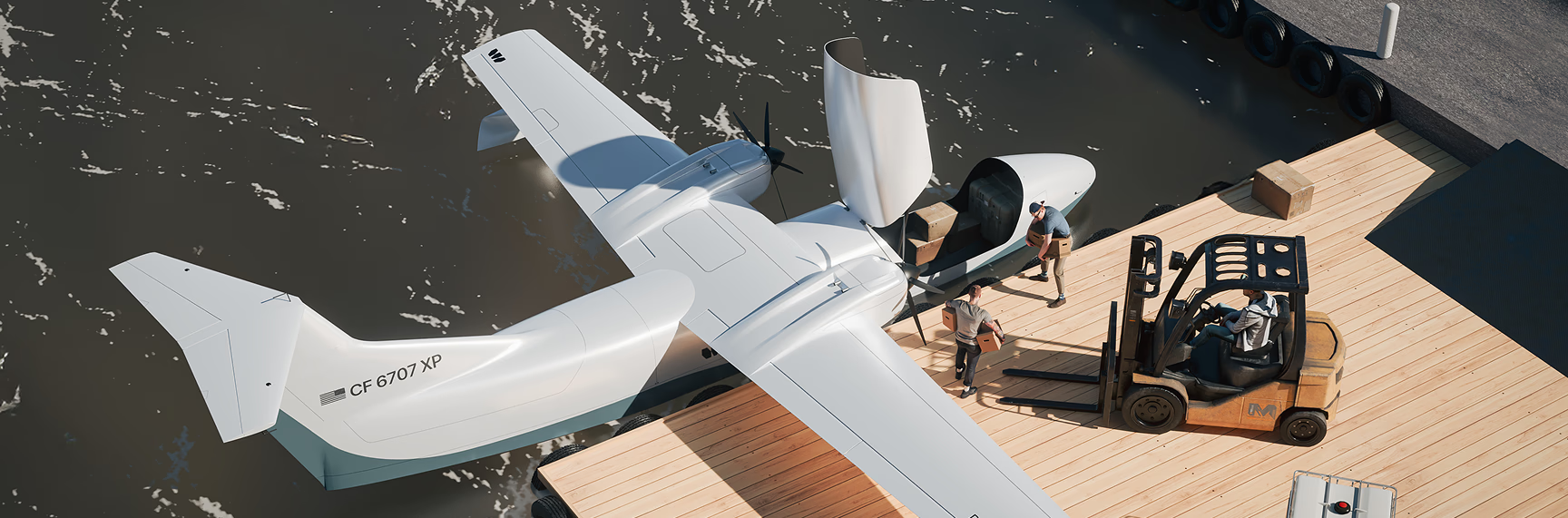
Poseidon is also developing a seaplane variant called Heron. Heron follows the same basic philosophy as Egret. It is designed around fixed-wing aviation and conventional engines. The aircraft could provide access to locations without traditional airports. That could make seaplane operations useful for remote communities. It also supports Poseidon’s broader focus on underserved routes. The company wants aircraft that can operate beyond major infrastructure. This approach could expand the number of locations it can serve.
Building The Aircraft
Poseidon has expanded into an old Navy hangar in Alameda, California. The larger facility gives the company room for full-scale development. The startup is also preparing for a major hiring push. It needs additional employees as aircraft development accelerates. Last year, Poseidon developed and flew a quarter-scale aircraft. That smaller aircraft was called Seagull. Testing Seagull helped the company develop its larger aircraft. The next major milestone is Egret’s first test flight.
Regulation Is Opening New Opportunities
Aviation startups have traditionally faced difficult regulatory challenges. However, the regulatory environment is gradually becoming more supportive. The Federal Aviation Administration recently introduced a pilot program. The program makes testing easier for certain advanced aircraft startups. Poseidon is not developing electric vertical takeoff aircraft. However, Zagaynov believes the company can still benefit. The changing regulatory environment creates more opportunities for aviation startups. He believes a commercialization path now exists that was previously limited. That could help Poseidon move from testing toward real operations.
The Bigger Picture
Poseidon Aerospace is betting on practicality rather than technological hype. Its aircraft use relatively familiar technologies with autonomous capabilities. The company is focused on one major problem: cargo transportation. By removing pilots, cockpits, and unnecessary weight, costs could fall. By using conventional engines, it avoids current battery limitations. By focusing on point-to-point routes, operations could become more flexible. Its defense strategy could also open another important market. The combination could create a different model for regional air cargo.
Final Thoughts
Poseidon Aerospace is approaching aviation from a logistics perspective. The company does not want technology to overshadow the actual problem. Its goal is to make cargo transportation cheaper and more efficient. The $60 million Series A gives Poseidon resources to move faster. Its Egret aircraft could become an important test of that strategy. The company expects its first full-scale test flight this year. If successful, Poseidon could challenge traditional ideas about regional cargo. Its autonomous aircraft could operate with fewer costs and limitations. For now, the company’s philosophy remains straightforward. Build a practical aircraft, reduce costs, and move cargo better.
Have an idea worth building?
Turn your ideas into scalable software with Techfilos. From product development to AI and cloud engineering, we build technology designed for real-world growth.